



“Premium,” “elite,” and “VIP” all suggest something special. On Japanese escort websites, however, they do not form a shared ladder of service levels. A premium escort is not automatically ranked below an elite companion, and “VIP” does not indicate a standard price or a fixed set of inclusions. These words describe an impression or a position within a particular business, and their meaning becomes clearer when you see what the business attaches them to.
Understanding this makes Japan’s luxury service language easier to enjoy. You can appreciate the promise of an elegant, private experience without mistaking an appealing description for a universal grade.
What Do “Premium,” “Elite,” and “VIP” Mean on Japanese Escort Websites?
The following examples show how these words may be used. Their meanings overlap, and each word may describe more than the aspect highlighted here.
How “Premium” Can Describe an Experience or Offering
“Premium” may describe the service as a whole. In that sense, it presents the experience as refined or above the ordinary. It may also appear in a business’s own descriptions to distinguish a particular offering rather than the entire service.
Our own wording shows both uses. Aoyama Princess describes a premium, private experience in our booking guide. On our Pricing page, “premium” also appears in the description of the Black Plus+ Class. The word suggests positioning, while the class name identifies the actual category. The word “premium” alone would not tell you which category is meant.
This is why “premium” may sound broad in one place and quite specific in another. The surrounding sentence does much of the work.
How “Elite” Can Emphasize a Selected Roster
“Elite” may draw attention to the women a service selects and the image it wants its roster to convey. For example, Madam RENA’s public introduction uses “elite” alongside its description of carefully selected companions with a sophisticated presence.
Here, the emphasis is on selection and presentation. The adjective itself does not indicate a professional qualification, a particular career history, or an individual companion’s language ability. Those are separate details that belong in each companion’s introduction.
How “VIP” Can Convey Individual Attention
“VIP” may express how a service wants its customers to feel treated. KINGSMAN TOKYO, for instance, uses the term alongside its explanation of a hospitality concept built around individual attention and thoughtful service.
In that context, “VIP” describes an approach to hospitality rather than a transferable grade. It creates an expectation of personal attention, but the business’s own description must supply the meaning. The letters alone do not indicate a separate package or what a booking includes.
These uses may overlap. A service may describe its experience as premium, its companions as elite, and its hospitality as VIP without referring to three different products.

Is there a shared standard behind the labels?
You should not read these words as Japan-wide escort grades. The public examples above attach them to different things: an experience, a class description, a roster, or a way of welcoming customers. They do not provide a common scale for translating one business’s wording into another’s.
A category defined by an individual shop is more specific. Its name belongs to that shop’s own system and may come with a description and a price. That meaning should stay with the shop that defines it. Our separate guide explains companion ranks without treating “premium,” “elite,” and “VIP” as a national ranking.

VIP Escorts in Tokyo: How Companion Ranks Work and What Changes as You Move Up | Aoyama Princess
VIP also has other meanings around Tokyo
The same letters appear well beyond escort services. At the Roppongi nightclub SEL OCTAGON TOKYO, “VIP” refers to table seating, including a premium seating category. VIP Limousine uses the word in the name of its airport transfer service. One refers to a place to sit; the other refers to a ride.
Neither meaning carries over to an escort booking. A VIP description on an escort website does not, by itself, imply nightclub access or a car service. In Tokyo, the word next to “VIP” matters as much as the letters themselves.
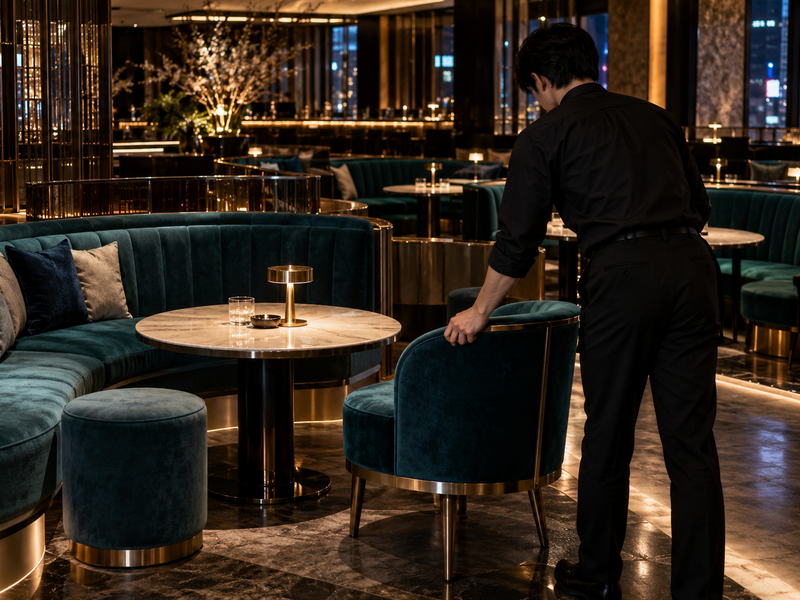
How Aoyama Princess gives its description substance
At Aoyama Princess, the private experience we describe is grounded in our approach to companions and hospitality. Our service introduction explains that selection considers manners, communication, and attitude as well as appearance. These qualities give elegance a human meaning: how someone presents herself and how she interacts with a customer.
Our roster includes women with backgrounds in modeling, gravure, and other entertainment fields. We introduce companions through photos and individual profiles, so their personality and presentation come through beyond a single adjective. A background adds context to an introduction, but it does not, by itself, define someone’s personality or the experience of spending time with her.
Privacy matters too. We describe how hotel information, booking details, and personal communications are kept confidential. Our booking guide explains our English support and hotel outcall service at selected hotels and approved accommodations. Together, these explanations give our language a clear setting: a companion, a private hotel visit, and support for international customers.

Can you trust a service because of its label?
A label can tell you how a business presents itself, but it cannot, on its own, establish the quality of an experience. The useful distinction is between a word that creates an expectation and the explanation that gives that expectation shape.
Once you understand that, “premium,” “elite,” and “VIP” become easier to read. They may express refinement, a selected roster, or individual attention, but the substance comes from the particular service being described. For the broader question of what a high-end Tokyo service offers, our luxury guide goes beyond the vocabulary.

Luxury Escorts in Tokyo: What a True High-End Service Offers and How to Compare | Aoyama Princess
Many Tokyo services use the word “luxury,” but it is a marketing description, not an official grade. A service can be considered high-end when rigorous companio...
About Aoyama Princess
Aoyama Princess is a hotel outcall service based in Aoyama, Tokyo. We describe our companions and hospitality through individual introductions and published service information, giving the language of a private, refined experience a specific meaning.
