



Tokyo AV Escorts: How Companion Ranks and Prices Are Set
Does having appeared in Japanese adult video, usually shortened to AV, mean a higher companion rank or a higher price? Our published FAQ and pricing pages do not specify an automatic rank or surcharge for AV acting experience. At Aoyama Princess, the FAQ describes a combined assessment, while the pricing pages list charges by class and course length.
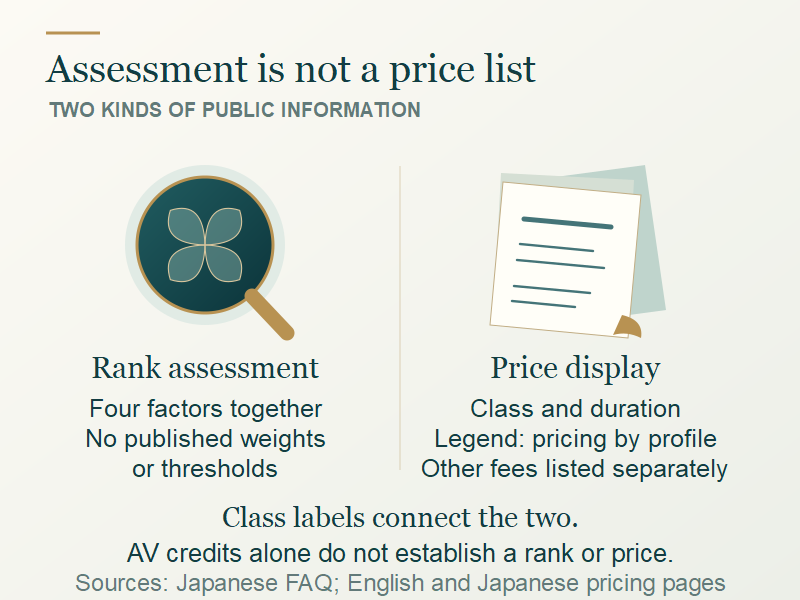
An acting credit describes a person’s career. A rank reflects the shop’s assessment; our pricing pages call these ranks “classes.” A rate is the published price for a class and course length, or for an individually priced profile.
What goes into a rank assessment?
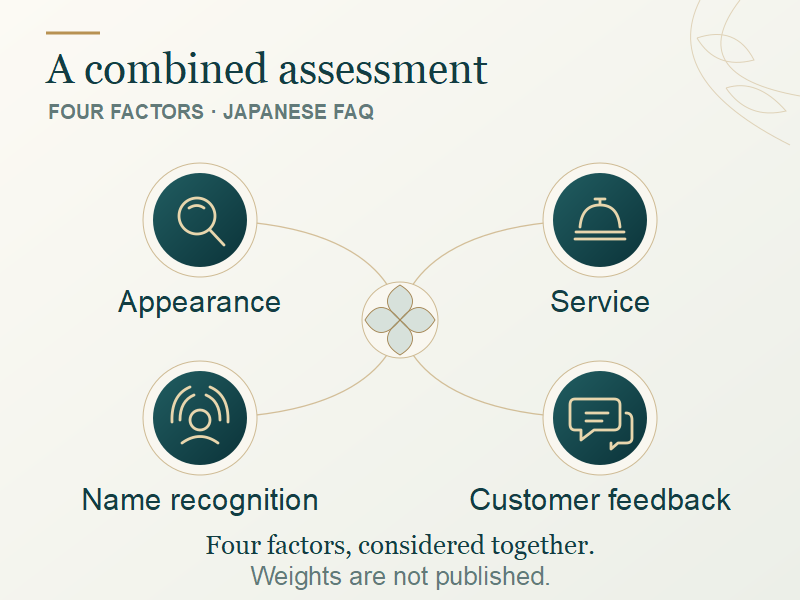
Our Japanese FAQ lists four factors: appearance, service, name recognition, and customer feedback. It states that all four are considered together, using more detailed evaluation criteria. The answer combines the shop’s own assessment with customer feedback, rather than naming an occupation as the basis for a rank.
A film credit cannot replace customer feedback, and appearance is only one of the four factors. The FAQ’s “service” factor refers to an assessment, not a list of specific acts or a promise about any individual.
How do ranks connect to published rates?
The class names link rank and price. On both the English and Japanese pricing pages, the standard classes have tables with separate rates for different course lengths and for extensions. The Legend Class works differently: Each companion’s rate is listed on her individual profile.
Within a class, the tables show different prices for different course lengths. Choosing a longer course changes the applicable rate without changing the class. The tables show the charges for each class, not the assessment that placed someone in it.
Companion-request fees, transportation fees, and a credit card surcharge are listed separately. Because they appear outside the class tables, a class rate is only part of the total charge. The English page also states that prices include tax and that prices and transportation fees may change.
Is selection for the roster the same as a rank assessment?
The class tables answer the price question, but other pages include information about backgrounds and assessment. The first distinction is recruitment, which the FAQ treats separately from rank. Our English Service page describes the screening that takes place before someone joins the roster: appearance, manners, communication, hospitality, service attitude, and health awareness. Its selection section also mentions presentation, responsibility, and communication with international customers.
Appearance and service appear in both the selection policy and the FAQ’s rank assessment, but the selection page provides neither weightings for the four factors nor thresholds between price classes.
Another distinction appears in the Japanese recruitment information. In a section on arrangements with limited public disclosure, it states that experience, achievements, and professional titles are considered when individual pay is assessed. This concerns what a companion may be paid, not the price a customer pays. Career background is therefore mentioned in the context of pay, and the page gives no rule that turns it into an AV-specific surcharge for customers.

JAV Escorts in Tokyo: Can You Really Meet an AV Actress, and How Does Booking Work? | Aoyama Princess
Searching for a “JAV escort” in Tokyo may bring a very specific picture to mind: finding an actress you have seen on screen, asking for her by name, and arrangi...
Does a place in the site rankings reveal a price class?
The Japanese homepage links separately to the pricing page and to a Ranking page. The Ranking page includes newcomer recommendations and lists organized under specific class names. A class name may therefore be used as the heading of a list as well as a label in a price table. Someone’s position in such a list and the class name above it are different pieces of information.
The Ranking page shows lists without explaining how positions are determined or how a position relates to a fee. A position within a class-specific list is not presented as a separate price class. The FAQ’s reference to customer feedback does not mean these lists are the feedback used in the rank assessment.
What can the pages establish about AV acting experience?
Name recognition might seem relevant to a public acting career. That is one possible reading of the term, but the FAQ itself does not make that connection. It does not define recognition in terms of AV credits or explain whether, or how, such credits affect any of the four factors.
For AV acting specifically, the key connection is not explained. The FAQ gives no relative weightings or thresholds between ranks. Neither that answer nor the two pricing pages mention an AV-specific class, a separate fee for an AV background, or a formula that turns acting experience into a price.
It would go too far to interpret that silence as a claim that acting experience never matters. Likewise, treating an AV credit as proof of a higher rank would add a rule the pages do not state. The published information supports neither conclusion.
Can AV acting experience alone determine a companion’s rank or price? No. The public explanation supports a combined assessment, not a price based on an acting credit.
Profile descriptions raise a related question: Which details of a career, including professional names, are made public?
About this explanation
Aoyama Princess operates a hotel outcall companion service in Tokyo. This article draws on our Japanese FAQ and our official pricing, ranking, recruitment, and selection pages.
